Vietnam’s pickleball scene has grown fast, and the rating side of it still feels a little improvised. DUPR, SportConnect, and PVNA all try to sort players by level, but they do it in different ways and for different reasons. That is why people keep ending up with three numbers instead of one.
If you want the short version: DUPR is the one people use when they want something global, SportConnect is the one that keeps local events moving, and PVNA is the homegrown system trying to become the standard inside Vietnam. All three matter. All three also create confusion.
DUPR
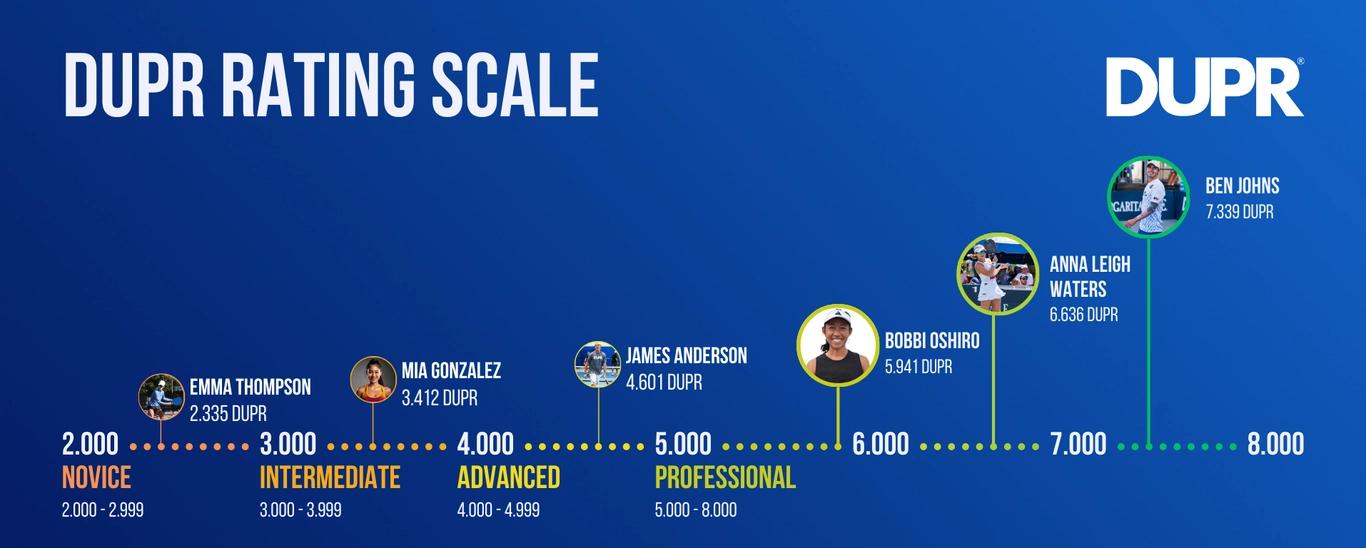
DUPR, or Dynamic Universal Pickleball Rating, is probably the best known pickleball rating system in the world. It is built on match results, so in theory it should reflect what happens on court instead of what someone says their level is. That is useful if you want a number that means the same thing in different places.
In Vietnam, DUPR matters most for players who want to move outside their own club circle. If someone wants to compare themselves with players in other countries, or turn up to a tournament with a rating people already understand, DUPR is the number they care about.
As a rough guide, DUPR tends to look something like this: 2.5 to 3.0 for beginners, 3.0 to 3.5 for improving intermediates, 3.5 to 4.0 for strong club players, 4.0 to 4.5 for advanced tournament players, and above 4.5 for top regional or pro level players. That is only a loose estimate, not an official conversion chart.
The problem with DUPR is not hard to see. Any system that depends on logged match results can be gamed. DUPR knows that, and its own rules say so pretty clearly. The community guidelines ban cheating, tanking, game fixing, manipulating results, and creating multiple accounts. DUPR has also put out policies for verified events, partly to cut down on fake accounts and fake match results.
That is all good, but it also tells you the system has to keep defending itself. People can still try to protect a rating with a throwaway account, skip matches they think will hurt them, or log games in ways that make them look better than they are. So yes, DUPR is trying to close the door on manipulation. It just cannot assume the door stays shut.
Official sites: https://www.dupr.com and https://www.dupr.com/community-guidelines
SportConnect
SportConnect is a different kind of tool. It is less about being a pure rating authority and more about making tournaments and events actually work. In Vietnam, that matters a lot. Players use it to register, organizers use it to seed draws and manage results, and clubs use it to keep local play organized.
That practical side is why SportConnect shows up everywhere. It is local, it is easy to use, and it fits the way the Vietnamese scene is growing. If DUPR is the passport, SportConnect is the desk where you check in.
A rough way to think about the levels is this: 1.0 to 2.0 for beginners, 2.0 to 3.0 for players still finding their footing, 3.0 to 4.0 for solid club and league players, and 4.0 and up for the stronger tournament crowd. That is not a direct DUPR equivalent. It is just a useful local shorthand.
The controversy around SportConnect is mostly about trust and clarity. When one platform sits in the middle of registration, seeding, and level assignment, people start asking how the numbers are produced and who gets to decide. If the system feels too opaque, players notice. They may not always say it out loud, but they notice.
There is also the bigger problem of scale mismatch. A player may use SportConnect for local events, then look at DUPR for something more portable, and the two numbers may not line up neatly. That is where the arguments start. Not because anyone is necessarily cheating, but because the systems are not speaking the same language.
Official sites: https://sportconnect.vn and https://apps.apple.com/vn/app/sport-connect/id6477529992
PVNA
PVNA is the most interesting one if you are watching the politics of the scene. It appears to stand for Pickleball Vietnam Association, and it presents itself as a ranking and tournament platform built for Vietnam. It is not just trying to list players. It is trying to become the system people trust.
PVNA seems to be used for rankings, events, and player management, and it has also been pretty open about rating fairness. That matters because the system has already had to deal with complaints about older ELO style formulas and the risk of point washing or rating gaming.
If you try to estimate the scale, the safest thing to say is that PVNA is not easy to translate cleanly into DUPR. A rough reading would be 2.0 to 3.0 for beginner to lower intermediate play, 3.0 to 4.0 for competitive club level, and 4.0 plus for serious tournament players. Even then, it is more of a local approximation than a real conversion.
PVNA’s own controversy is pretty straightforward. It has had to acknowledge that the rating formula can be gamed, which is why it has discussed changes to the system and why people keep debating whether it is fair enough. On one level, that is a good sign because it shows the platform is paying attention. On another level, it means the integrity issue is real, not theoretical.
PVNA also has a legitimacy problem to solve. DUPR already has global reach. SportConnect already has local traction. PVNA has to earn trust in the middle of that, and that is not easy. People do not just want a new badge. They want to know the number means something.
Official sites: https://pvna.vn and https://apps.apple.com/vn/app/pvna-x%E1%BA%BFp-h%E1%BA%A1ng-pickleball/id6749922792
Why the whole thing feels messy
The main issue in Vietnam is not that one system is clearly winning. It is that all three are being used at the same time. That means one player can be a different level depending on where they are playing and who is running the event. It is a headache for organizers and, honestly, a headache for players too.
Once ratings start affecting brackets, bragging rights, and prize money, people will try to work the system. That is not a Vietnam-only problem, but it is very visible here because the scene is moving so quickly and the standards are still being sorted out.
So the real story is not that Vietnam lacks ratings. It is that it has too many ratings, each with a slightly different job. DUPR gives players a global reference. SportConnect keeps the domestic machinery running. PVNA is trying to build a local standard that people will actually accept. That is the mix right now, and it explains why everyone keeps talking past one another.
For the moment, that is where things stand. The scene is growing fast, the systems are still sorting themselves out, and the arguments around fairness are probably not going away anytime soon. If anything, they are part of the sport now.